

Trauma is the psychological, emotional, and physical response to an overwhelming experience, while PTSD is a mental health condition that can develop after certain traumatic events.
Maybe something happened years ago, but you still notice how it affects your relationships. Or perhaps a recent experience has left you feeling anxious, disconnected, or unusually alert.
How can you tell if what you’re experiencing is a response to trauma or a sign of PTSD? Let’s look at the differences, the symptoms to watch for, and how trauma therapy can help.
Difference between trauma and PTSD
Trauma is what an overwhelming event leaves behind in your mind and body. PTSD is a diagnosis that can develop when trauma-related symptoms last longer and disrupt daily life.
The table below compares trauma and PTSD by symptoms, duration, impact, and diagnosis:
| Feature | Trauma | PTSD |
|---|---|---|
| Definition | A distressing or overwhelming experience and its effects | A diagnosable mental health condition that can develop after certain traumatic events |
| Duration | Effects may last days, months, or years | Symptoms persist for more than one month |
| Symptoms | Fear, sadness, anxiety, sleep problems, or emotional distress | Includes intrusive symptoms, avoidance, negative changes in mood or thoughts, and heightened reactivity |
| Impact | Can affect emotions, relationships, and daily life, sometimes long-term | Causes significant distress or difficulty functioning in important areas of life |
| Diagnosis | Trauma itself is not a mental health diagnosis | Diagnosed by a qualified clinician using specific criteria |
When does trauma become PTSD?
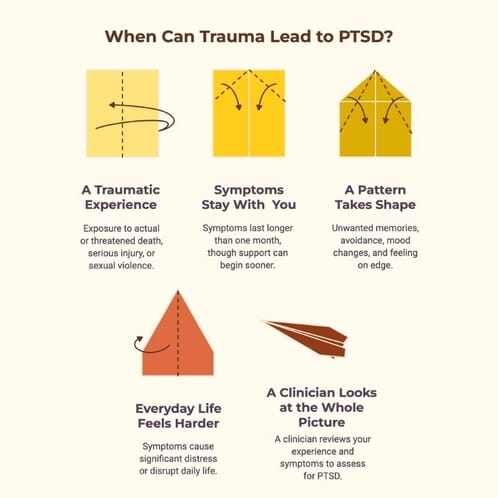
Trauma may lead to PTSD when symptoms last longer than one month, follow a PTSD symptom pattern, and cause significant distress or interfere with daily life.
A PTSD diagnosis requires exposure to actual or threatened death, serious injury, or sexual violence. This exposure can be direct, witnessed, or indirect in circumstances that meet the diagnostic criteria. A clinician also checks that symptoms aren’t caused by medication, substance use, or another medical condition.
Symptoms last longer than one month
PTSD symptoms must last longer than one month to meet the diagnostic criteria. According to the National Institute of Mental Health (NIMH), symptoms usually begin within three months of a traumatic event, although they can appear later.
Feeling anxious or overwhelmed after trauma doesn’t automatically mean you have PTSD. Some reactions improve with time, but you don’t need to wait a month to seek support.
Symptoms match a PTSD pattern
PTSD involves four groups of symptoms: intrusion, avoidance, negative changes in mood or thinking, and changes in alertness or reactivity.
For an adult diagnosis, a clinician looks for at least one intrusion symptom, one avoidance symptom, two mood or thinking symptoms, and two alertness or reactivity symptoms, assessed as a pattern rather than in isolation.
Daily life becomes harder to manage
PTSD symptoms cause significant distress or interfere with important parts of life, such as work, relationships, or everyday responsibilities. You might find it harder to concentrate, feel comfortable around others, or participate in activities you once enjoyed.
Common PTSD symptoms
 Common PTSD symptoms show up in how you remember, react, feel, and relate to others. Even in safe situations, your mind and body may react as if danger were still present. Here is what these symptoms can look like day to day:
- Memories, nightmares, or flashbacks of the event that you did not ask for
- Avoiding places, people, conversations, or feelings that bring the event back
- Guilt, shame, or anger, or feeling numb and cut off from others
- Feeling on guard, easily startled, or unable to relax
- Trouble falling asleep, staying asleep, or concentrating
- Irritability or outbursts that feel out of character
Anxiety and depression can cause some of these symptoms too. A mental health professional can help you sort out what is happening, one step at a time.
PTSD vs related trauma conditions
 Acute stress disorder and complex PTSD are related diagnoses. Childhood trauma describes experiences that may or may not lead to PTSD.
PTSD vs acute stress disorder
Timing is one key difference, but the diagnostic criteria also differ. Acute stress disorder (ASD) involves symptoms lasting from three days to one month after trauma. PTSD requires symptoms lasting longer than one month and a specific pattern across four symptom groups.
Both can involve intrusive memories, avoiding reminders of what happened, and feeling constantly on edge. Having ASD doesn’t mean you’ll develop PTSD, and you can seek support for either condition.
Childhood trauma vs PTSD
Childhood trauma can come from experiences such as neglect, abuse, or growing up without feeling emotionally safe. PTSD is a condition that can develop after certain traumatic experiences at any age.
Not everyone who experiences childhood trauma develops PTSD. However, you may find it difficult to set boundaries, trust others, or feel secure in relationships as an adult. These are concerns that therapy for relational trauma can help you work through.
CPTSD vs PTSD
PTSD can develop after one traumatic experience, such as a serious accident or assault, or after repeated trauma. Complex PTSD (CPTSD) is more often linked to prolonged and repeated trauma, especially when someone feels unable to escape.
In ICD-11, complex PTSD includes PTSD symptoms plus persistent difficulties regulating emotions, a deeply negative view of yourself, and difficulties maintaining relationships. CPTSD is recognized separately in ICD-11, the World Health Organization’s classification, but it isn’t a separate diagnosis in DSM-5-TR, the diagnostic manual commonly used in the United States.
How can trauma therapy help?
 Trauma therapy can help you process distressing experiences, understand emotional reactions, and develop healthier ways of responding to situations that feel overwhelming. Approaches such as EMDR, IFS-informed therapy, and relational healing can support this process.
EMDR for trauma processing
Eye Movement Desensitization and Reprocessing (EMDR) therapy is a structured approach that helps people process distressing memories. While you focus on a distressing memory, the therapist guides bilateral stimulation, which means alternating eye movements, taps, or sounds from left to right.
The memory stays with you, but its emotional charge usually softens, so it has less power over your reactions.
IFS-informed therapy for deeper patterns
Internal Family Systems (IFS) explores different parts of yourself that may have developed protective responses to difficult experiences.
For example, one part of you might want connection while another pulls away to avoid getting hurt. IFS-informed therapy helps you approach these reactions with curiosity and compassion rather than judgment, supporting greater emotional awareness and self-understanding.
Relational healing for trust and self-worth
Relational healing helps you build trust and self-worth by looking at how painful relationships shaped what you expect from others and how you see yourself. You might find it hard to say no, ask for what you need, or believe that people will stay.
In therapy, we look at where these patterns began and how they show up today, so your connections can feel safer over time.
Trauma deserves support, even without a PTSD diagnosis
You don’t need a PTSD diagnosis to seek support. If past experiences are affecting your sleep, relationships, or how you feel about yourself, you deserve a space where you can talk openly and feel heard.
I’m Debbie Carter, a licensed professional counselor and certified EMDR therapist in Denver. I offer in-person therapy in Denver and online therapy throughout Colorado. I can help you work through what you’ve been experiencing and feel more at ease with yourself and others.
Get a Free Consultation to share your concerns, ask questions, and see if working with me feels right for you.
FAQs about trauma and PTSD
Can you be traumatized but not have PTSD?
Yes. You can experience trauma and continue to struggle with anxiety, shame, trust, or emotional distress without meeting the criteria for PTSD. Trauma can affect your well-being in different ways, and a diagnosis isn’t required to benefit from therapy.
How do you confirm if you have PTSD?
A qualified mental health professional can assess PTSD by reviewing your experiences, symptoms, their duration, and their effects on everyday life. Screening questionnaires may help identify possible PTSD, but they don’t replace a clinical assessment.
Why do some traumatized people develop PTSD while others don’t?
Several factors can influence PTSD risk, including the nature of the experience, previous trauma, available support, and individual vulnerabilities. People respond differently to distressing events. Developing PTSD isn’t a reflection of someone’s strength or ability to cope.
How long can PTSD last without treatment?
PTSD can last months or years without treatment. Some people experience improvement, while others continue to struggle with symptoms that affect daily life. Trauma-focused therapy can help, including when the original experience happened years ago.
Can you heal from trauma without remembering everything?
Yes. You don’t need to remember every detail of a traumatic experience to benefit from therapy. Treatment can address the memories you have, along with current emotions, beliefs, physical reactions, and relationship difficulties. A therapist can help you work with these experiences without pressuring you to recover missing memories.