

Insurance may cover EMDR therapy when your plan includes outpatient mental health benefits, the treatment is medically necessary, and the therapist meets the plan’s requirements. Your network status, deductible, copay, and session format determine how much you pay.
Insurance questions can add another layer of stress when you are already deciding how to address trauma, anxiety, or painful memories. A therapist may provide EMDR, but that does not automatically mean every session or expense will be covered.
Here is how to check your EMDR benefits, estimate possible costs, and know what to ask your insurance company before scheduling treatment.
Does insurance cover EMDR therapy in Denver?
 Insurance may cover Eye Movement Desensitization and Reprocessing as outpatient psychotherapy rather than listing EMDR as a separate benefit.
What you pay depends on your deductible, copay, session length, and the therapist’s network status. An in-network therapist bills your plan directly. With an out-of-network therapist, you may pay upfront and submit a superbill for possible reimbursement.
Call the number on your insurance card to confirm your benefits. Ask about outpatient psychotherapy coverage, authorization requirements, and your expected cost per session.
What determines EMDR therapy cost with insurance?
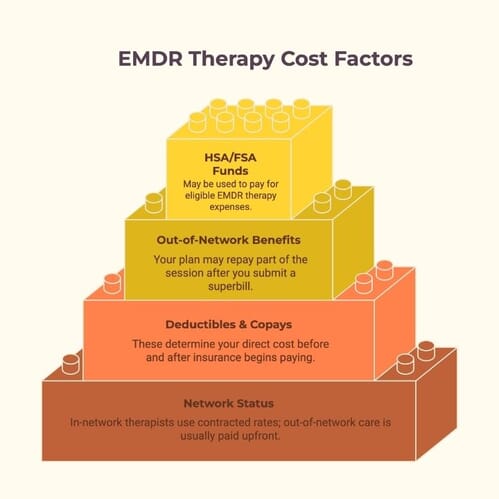 Your EMDR therapy cost with insurance depends on the therapist’s network status, your remaining deductible, and the percentage your plan pays. The billed fee and the insurer’s allowed amount may also be different.
Network status controls the reimbursement pathway
An in-network therapist has agreed to your insurer’s rates and usually submits claims for you. An out-of-network therapist is paid directly and may provide documents for you to request reimbursement. Because network participation can vary by plan, confirm the therapist’s status with both the practice and your insurance company.
Deductibles, copays, and coinsurance affect what you pay
Your deductible, copay, and coinsurance determine how much you may pay for each EMDR session. According to the HealthCare.gov glossary, a deductible is the amount you pay before your plan begins covering eligible services, while coinsurance is the percentage you pay after meeting that deductible. A copay is a fixed charge for care.
Out-of-network benefits may reimburse part of a superbill
A superbill is a detailed receipt you submit to your insurer after paying an out-of-network therapist. It includes the information needed to review your claim.
Reimbursement depends on your benefits, deductible, and the insurer’s approved rate. Receiving a superbill does not guarantee that your plan will reimburse the session.
HSA and FSA funds may cover eligible therapy expenses
Health Savings Account and Flexible Spending Account funds may help cover eligible EMDR therapy expenses. According to IRS Publication 502, qualifying medical expenses include certain payments for psychiatric and psychological care.
Confirm that your sessions meet your account’s requirements and keep your receipts in case the administrator requests documentation.
Does Medicare cover EMDR therapy?
 Medicare may cover EMDR when it is provided as medically necessary psychotherapy by a Medicare-enrolled mental health professional. Coverage applies to the therapy service rather than the EMDR method itself.
According to Medicare.gov, Medicare Part B covers individual psychotherapy with eligible licensed professionals. After meeting the Part B deductible, you generally pay 20 percent of the Medicare-approved amount when the provider accepts assignment.
Confirm that the therapist accepts Medicare and that your treatment meets the plan’s requirements. Medicare Advantage plans may have separate network, authorization, and cost-sharing rules. A superbill from an out-of-network therapist does not guarantee Medicare reimbursement.
How Debbie Carter handles EMDR fees and insurance
 The majority of my clients use private pay, which means they pay me directly for each session. Clients with out-of-network benefits can request a superbill to submit to their insurance company for possible partial reimbursement.
I also offer in-network coverage for Aetna, Quest Behavioral Health, and Select Health Colorado through a third-party billing company. Coverage depends on your specific plan, so please confirm your benefits before scheduling.
Fees may also vary based on the length and format of treatment, including EMDR intensives in Denver. We can discuss payment, insurance, and superbills during your consultation.
Confirm your coverage before starting EMDR therapy
 Calling your insurance company can help you understand what your plan may cover and what you may need to pay. Ask about outpatient psychotherapy because EMDR may not appear as a separate benefit.
Have these details available:
- Your therapist’s name and credentials
- National Provider Identifier
- Practice location
- Session length and fee
- Psychotherapy billing code
Write down the representative’s name, the date, and the call reference number. You can also request a written summary of your benefits, since coverage discussed by phone does not guarantee reimbursement.
Cost matters, but so do the therapist’s experience, approach, and session format. Learning what EMDR therapy is like can help you consider the care itself alongside your coverage.
Discuss EMDR Therapy in Denver During a Free Consultation
Coverage questions deserve clear answers before therapy begins. Review your mental health benefits, remaining deductible, reimbursement rate, and session limits. Then bring any unanswered questions to your consultation.
I offer EMDR therapy for adults working through trauma, anxiety, depression, postpartum concerns, and painful relationship patterns. Treatment may also address early experiences through EMDR for relational trauma.
Get a Free Consultation to discuss the therapy format, current fees, superbills, and what you would like help changing.
Frequently Asked Questions About EMDR Therapy
What are the 8 phases of EMDR?
The eight phases are history taking, preparation, assessment, desensitization, installation, body scan, closure, and reevaluation. Treatment moves through these phases according to your needs and readiness.
Do you talk during EMDR?
Yes, but you do not need to describe every detail of the memory. You briefly share what you notice so the therapist can guide the processing while respecting your boundaries.
Does EMDR work without remembering the trauma?
EMDR may address emotions, beliefs, body sensations, or fragments connected to an experience without a complete memory. A trained therapist determines what can be approached safely without trying to force memories to appear.
When is EMDR not recommended?
EMDR processing may be delayed when immediate safety concerns, severe instability, active substance withdrawal, or limited coping resources require attention first. Preparation or another level of care may be needed before trauma processing.
Where can I receive EMDR therapy in Colorado?
I offer in-person EMDR therapy at 1325 S. Colorado Blvd., Suite B-108 in Denver. I also provide virtual appointments for clients located anywhere in Colorado at the time of the session.